Most self-hosting guides I read assume you speak English. Pick the biggest model your card can hold, check a leaderboard and call it a day. Then I tried to run a family assistant in Swedish on a 16 GB graphics card, and the leaderboard stopped being useful about ten minutes in.
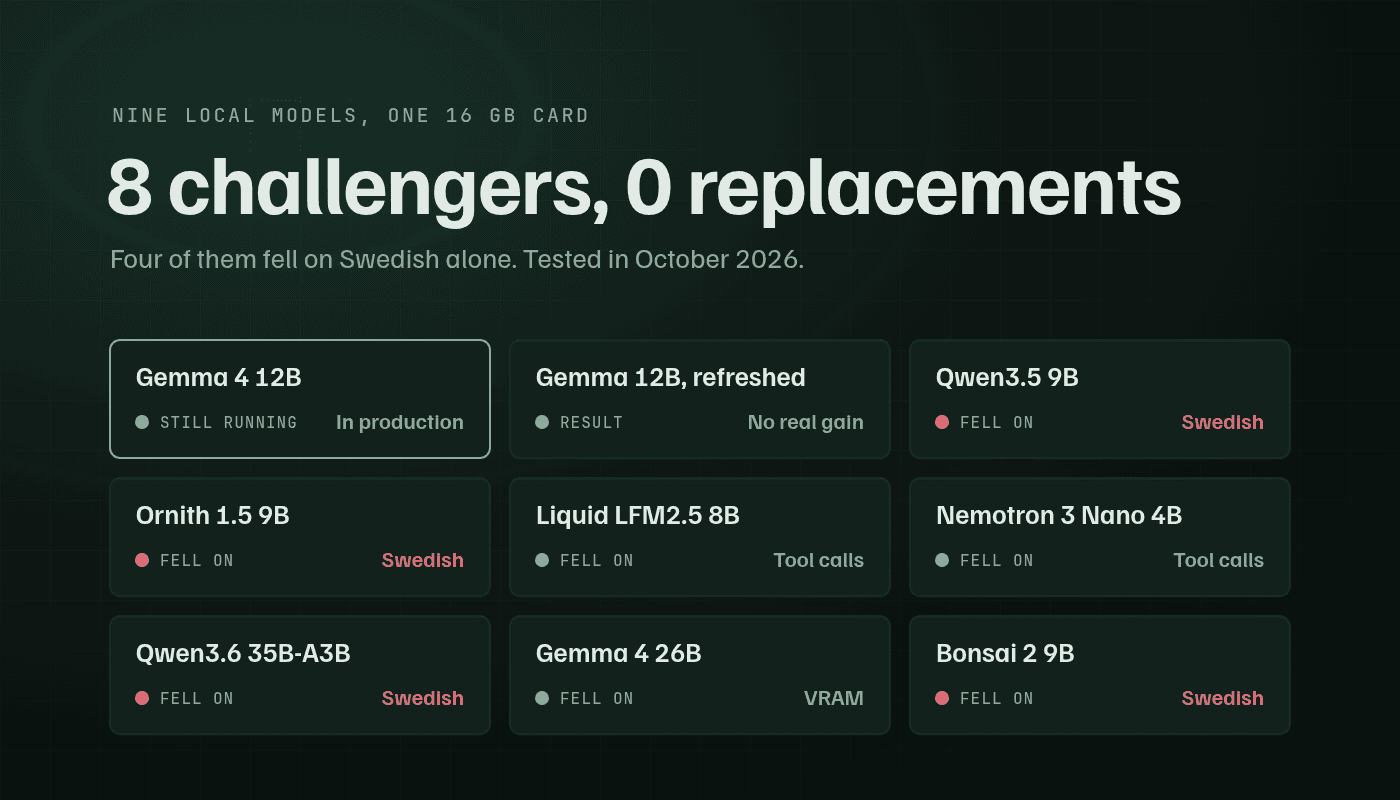
This October I therefore put nine local models through the same tests on the same card. Eight of them challenged the model we already run, Gemma 4 12B. Sadly, none of them could replace it. Four fell on Swedish alone. This is what those tests showed, and what it takes to run a Swedish household local first.
Freya, and why she has to speak Swedish
Freya is our family assistant. At seven every morning she sends the day: calendar appointments, a warning if an activity has no parent assigned to it, a quote of the day, and the school lunch, so we do not cook the same thing for dinner that day. A second message is just for me, the AI news worth a look. During the day she sends reminders: pack the gym bag the evening before the youngest has sports, medicine reminders early in the morning. Lately she also keeps track of the children's chores, dishwasher, recycling and laundry, in a three-week rotation, so nobody can claim they did not know whose turn it was.
Doing it all in English would have been simpler. But when I started on voice, Swedish felt like the only natural way to bring her into the family. That first introduction did not go smoothly either. When Freya joined the family WhatsApp group, the pushback made me pull her out and rework the format, so the long calendar messages now only go to the parents. A family's trust is easier to lose than to win, and an assistant that talks to them in another language starts at a disadvantage.
The moment the language stopped being a preference was the meal planner. Matching recipes to what we actually call dishes, and building shopping lists with the Swedish names on the shelf, only works if the model knows Swedish food and Swedish words. There have been challenges there with formats: 10 tomatoes is not the same as 10 cans of tomatoes, and smörgåsgurka, even on sale, is not the cucumber we put in tzatziki. But every iteration brings us closer to a solution that works, and in the long run we save money on grocery shopping, about 1,000-2,000 kr a month.
How we tested
I did not trust public leaderboards for this, for a simple reason: they measure coding and problem solving, and my system does neither locally. It runs on my hardware, uses voice, and calls tools. So the tests measure that.
Every phase used the same shape:
- Direct tool calls: 24 frozen English cases. Does the model call the right tool with the right arguments, and does it stop when it should?
- Native Freya turns: real isolated OpenClaw sessions with inert tools. Lights, reminders that get moved, a weekly rule for both parents, a backend that is down. Half in Swedish, half in English in the later phases.
- Swedish prose: short everyday questions, graded blind by me without knowing which model wrote what.
- Long context: three codes hidden in a 58,000-token prompt.
- Fresh control: Gemma 12B ran again in every phase, so each candidate is compared to the same model on the same day.
Nothing touched the real setup in the house. Every tool was a mock that only recorded what the model tried to do.
The blind rating turned out to be the most fun part. When you host your own models it is easy to get fixated on the B, the billions of parameters, and squeeze in the largest model your card can hold. With the names hidden, that number disappears and only the Swedish is left to benchmark on. In the last round I rated four everyday answers from three models, letters shuffled, and opened the key only when all four were done. Gemma 12B never scored below 4 and averaged 4.25 out of 5. Qwen3.5 9B landed at 3.25. The scores only compare answers within one sheet: the same Gemma answers got 4.875 when they sat beside Bonsai's. Ornith 1.5 9B, the model that had just passed every Swedish tool turn, came last at 2.5: mörkaka in a pasta recipe, a Thai word in the middle of a sentence, and a bedtime tip I still cannot parse, säg allt du har på dig rakt ur dig på ett papper. All three did equally well on the easy one, a polite refusal to switch off a lamp. The differences only showed once an answer had to be longer than two sentences.
What the models got wrong
| Model | Tested in | Strongest | Fell on |
|---|---|---|---|
| Gemma 4 12B (production) | SV + EN | Top-rated Swedish in every blind rating, tool calls 23/24 | Drops a trailing period, once claimed a dimming it never did |
| Gemma 12B, refreshed package | SV | Same Swedish, faster turns | No real gain |
| Qwen3.5 9B | SV + EN | 8/8 English turns | Swedish 3.25/5, rejected Swedish reminder arguments |
| Ornith 1.5 9B | SV + EN | Best exact text of all | Invented Swedish words, Chinese and Persian mixed in |
| Liquid LFM2.5 8B | EN | Fastest | Tool turns 11/24, read its reasoning out loud |
| Nemotron 3 Nano 4B | EN | Small and fast | Tool turns 13/24, empty answers |
| Qwen3.6 35B-A3B | EN | Best reasoning and code | ~1 GB VRAM left, malformed Swedish |
| Gemma 4 26B | SV + EN | 16/16 turns, much faster | Did not fit beside our mail classifier |
| Bonsai 2 9B | SV + EN | Twice the speed, half the VRAM, 8/8 English | 5/8 Swedish, Norwegian and Danish mixed in |
The invented Swedish words made me laugh. Ljusbåten, a light boat, for a lamp. Påminnet, a word that does not exist. Grammar is the easiest thing to judge as a human, because a mangled native word jumps off the screen, and it is also the most deflating, because you were hoping you had finally found a working model. Tone was harder. Some answers were genuinely charming, and I caught myself being pleased when a model added a small "should I do that?" at the end.
The failures I care about are different. A model that says "done" when it did nothing is a red flag for me, because the lights are switched every single day. If Freya believes she dimmed the living room when she did not, someone has to notice, find out why, and fix it. Clumsy Swedish is the opposite kind of failure: it does not break anything, but it tells you the model is a poor match, and there is no setting that fixes it. Between the two, I can forgive a failed task faster than a family can learn to trust a model that spells obvious words wrong.
The last round was interesting. I expected English to make the tool calls easier for everyone. It did for Qwen3.5 (8/8 in English, 6/8 in Swedish) and for Bonsai. Ornith did better in Swedish. Gemma, our control, got stuck in a thinking loop in English, repeating "Wait, I'll do it. Actually, I'll use the tool." until it timed out. So the honest conclusion is narrower than my starting thesis: the tool calls do not reliably care about language. The prose does. That is the part only Gemma got right.
What it costs
Electricity is not the deciding factor. I measured the card: keeping Gemma loaded around the clock adds about 1.4 W over an empty card, roughly 1 kWh a month. A Swedish answer costs 0.63 Wh. A thousand of them is about the energy of a load of laundry.
The price is the card and what it can no longer do. I bought the RTX 5060 Ti 16 GB for 5,995 kr. Today the same card costs 10,490 kr at Webhallen. That rules out the obvious next step, a second card for bigger models. And a GeForce RTX 5090 starts at 62,000 kr. I was around when the Voodoo Graphics came out in 1996, and I never imagined a card made for gamers would cost more than a used car.
Gemma takes 8.5 GB of the 16. Next to it sits a mail classifier on the same model, and earlier a voice service that needed almost 4 GB on its own. There was simply no room left for Gemma, voice and my casual gaming at once, so the gaming moved to GeForce NOW at about 120 kr a month, 1,440 kr a year. The card I bought is four years of GeForce NOW. At today's price it is seven.
This is where the language shows up on the bill. In English I could go smaller, not bigger. Bonsai did every English task in 5.1 GB at twice the speed. A model that size leaves room for gaming on the same card. So part of what I pay GeForce NOW for is really the price of Swedish.
Advice for other small-language households
If it is a solo project, for you alone, use English. You will probably find a model that fits your needs, and it will likely be smaller than you think.
If it is for a family, start with your native language as the first benchmark, before speed or size. It makes every later idea easier to build, and it is the only way to get the family's approval.
What would make me switch away from Gemma? A larger model with real reasoning that comes closer to the frontier models I use at work, and that writes Swedish my family accepts. Until then, my model-watch agent is not allowed to call anything a candidate without published Swedish results for that exact model.
Keep the sensitive part local
Keep your sensitive data on a local model. Our mail never leaves the box. Everyday chat can fall back to the cloud, and we chose that on purpose. You still do not know what cloud data will be used for in the future.